
Commercial · Modified Bitumen
Asphalt toughness, rolled out.
Granule-surfaced asphalt sheets, torch- or cold-applied, the practical choice for smaller commercial roofs and buildings that mix flat and sloped sections.
Where mod-bit fits
Small commercial. Mixed rooflines.
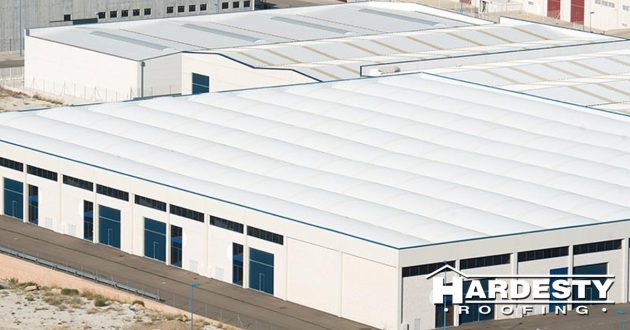
Modified bitumen bridges the gap between shingles and single-ply: it handles low-slope sections a shingle can't, ties cleanly into steep-slope sections a membrane shouldn't, and its granulated surface takes foot traffic without ceremony.
For the strip-mall, the small office, and the mixed-roofline building, it's often the most cost-effective honest answer.
Commercial services
The rest of the flat-roof toolbox.
TPO
Heat-welded single-ply with a reflective white surface that cuts summer cooling loads. The workhorse for warehouses and big open decks.
Learn moreEPDM
The proven black rubber membrane, decades of field history, excellent in freeze-thaw, and economical to repair as it ages.
Learn morePVC
Chemically resistant and heat-welded, the right answer over kitchens, labs, and anywhere grease or chemicals hit the roof.
Learn moreBuilt-Up (BUR)
Multiple asphalt plies with redundancy built in, a heavyweight for roofs with heavy foot traffic and long ownership horizons.
Learn moreCommercial Repair
Leaks at curbs, seams, and drains, found, documented, and fixed before they reach the deck.
Learn moreFlat Roof Repair
Ponding, blistering, open seams, and failed flashings on any of the five major membrane systems.
Learn moreQuick answer
Hardesty Roofing installs and repairs modified bitumen roofing across Central Virginia. Modified bitumen is an asphalt based membrane reinforced with polyester or fiberglass and installed in multiple plies, which gives it strong puncture resistance and makes it a good choice for roofs that see regular foot traffic. Class A licensed, roofing from Midlothian since 1990. Call 804-523-9955.
What modified bitumen is
Asphalt, modified with polymer, in layers.
Modified bitumen is the modern descendant of built up roofing. It takes asphalt, modifies it with polymer to improve flexibility and temperature performance, reinforces it with a polyester or fiberglass mat, and supplies it in rolls rather than as a hot mopped assembly. It is installed in multiple plies, typically a base sheet and a cap sheet.
The two polymer families behave differently. SBS modified is rubberised and stays flexible in cold, which suits buildings that move. APP modified is more plastic in character and handles heat well. Which one belongs on your roof depends on the building and on how the membrane will be applied.
- Multi ply
Base sheet plus cap sheet. Layers give redundancy that a single ply membrane does not have.
- Toughness
Good puncture and traffic resistance, which is why it suits roofs technicians walk regularly.
- Application
Torch applied, cold adhesive or self adhered. Cold and self adhered avoid open flame on the roof entirely.
What it costs
What drives a modified bitumen number.
Modified bitumen is generally priced between the single ply systems and a full built up roof. The number of plies and the application method are the main variables, along with the usual insulation and drainage work underneath.
One consideration worth raising early: torch application involves an open flame on the roof. On occupied buildings, or where the substrate or adjacent construction makes that unwise, cold adhesive and self adhered systems avoid it. That choice can affect both cost and whether the work can happen during business hours.
- Number of plies
A two ply system costs more than a single cap sheet and gives redundancy that matters on a roof you intend to keep.
- Application method
Torch applied, cold adhesive or self adhered. Self adhered is generally the most expensive material and the safest to install.
- Surfacing
Granulated cap sheets protect the membrane from UV and affect both appearance and service life.
- Insulation and drainage
Energy code driven insulation, plus any tapered work needed where the roof ponds.
What to expect
How a modified bitumen roof goes on.
Free inspection
We assess the existing roof and substrate, probe for saturated insulation, review drainage and traffic patterns, and confirm whether torch application is appropriate for the building before specifying anything.
Written estimate
You get a written estimate with the options laid out and no vague line items. We explain the tradeoffs and give you our honest recommendation, including when the cheaper option is the right one.
Scheduled work
We schedule around you and show up when we said we would. Crews protect landscaping and vehicles, and magnet-sweep for nails at the end of every working day, not just the last one.
Final walk and paperwork
We walk the finished job with you, answer anything still open, and hand over the warranty documentation. Manufacturer coverage gets registered at closeout, because it is not real until it is registered.
Warranty
Two promises, and they are not the same promise.
Commercial roofs carry two separate warranties. The membrane manufacturer warrants the material and, on some systems, the installed assembly. Hardesty warrants the workmanship. They are different promises with different terms.
Membrane warranty length varies widely by system, by membrane thickness, and by whether the manufacturer inspects the finished job. We tell you what the specific assembly qualifies for before the work is specified, not after.
- 5 yrs
Hardesty's own workmanship warranty on labor. If our installation fails, we come back and fix it.
- Varies
Membrane coverage is set by the manufacturer and varies by system and thickness. Longer terms generally require heavier membrane and a manufacturer-inspected installation.
- In writing
You get the term for the exact material you choose, in writing, before you sign anything.
Common questions
Modified bitumen questions.
Is modified bitumen the same as a tar roof?
It is the modern relative of one. Traditional built up roofing is hot mopped asphalt and felt layers. Modified bitumen takes the same asphalt base, modifies it with polymer for flexibility, reinforces it and supplies it in rolls. Same family, considerably better material.
What is the difference between SBS and APP?
Both are polymers used to modify the asphalt. SBS is rubberised and stays flexible in cold, which suits buildings that move or see hard freeze thaw. APP is more plastic in character and handles heat well. The application method differs between them too.
Does it have to be torched on?
No. Torch application is one method, and cold adhesive and self adhered systems avoid open flame entirely. On occupied buildings that is often the better choice, and we will raise it during the assessment rather than after.
Is it better than single ply?
Different rather than better. Multi ply construction gives redundancy and better puncture resistance, which matters on roofs with regular foot traffic. Single ply is lighter and faster to install. The building decides.
How long does modified bitumen last?
Service life depends on the number of plies, the surfacing, and whether the roof drains properly. A two ply granulated system that sheds water well substantially outlasts a single cap sheet on a roof that ponds.
Can it be repaired?
Yes, and it repairs well. The multi ply construction means damage often does not penetrate every layer, which is part of the redundancy argument for the system.
Can we walk on it?
It handles foot traffic better than most single ply membranes, which is a large part of why it gets specified on roofs with rooftop equipment that needs regular service.
Can it go over our existing roof?
Sometimes, depending on what is already there, how many layers, and whether the insulation is dry. We check before recommending it.
Free Estimate
Put a Hardesty roof over it.
Walk-throughs and estimates are free, written, and scoped for your budget cycle, repair, restore, or replace.
804-523-9955Prefer to talk? Call the shop directly. 14430 Sommerville Court, Suite B · Midlothian, VA 23113
Worried about the cost? We offer in-house financing. Ask and we will walk you through it.
Ask About Financing