
Commercial · TPO
The workhorse of the flat roof.
Heat-welded single-ply with a reflective surface that cuts summer cooling loads, the most-installed commercial membrane in America, for good reasons.
Where TPO fits
Big decks. Hot sun. Tight budgets.
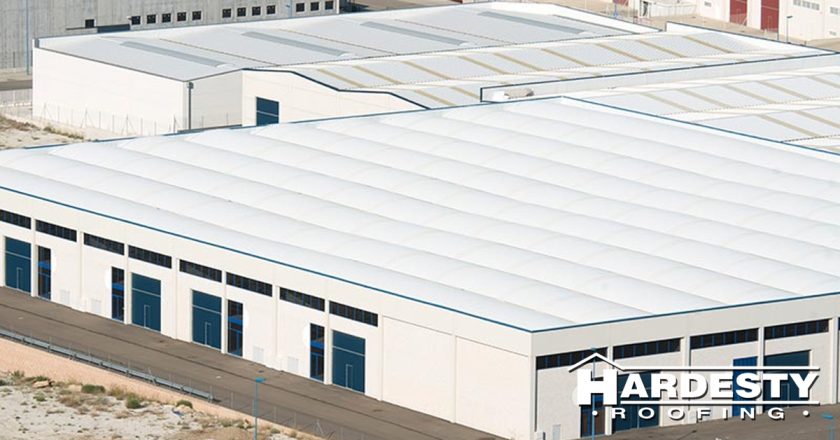
TPO's welded seams are stronger than the sheet itself, its white surface reflects Virginia's July sun instead of absorbing it, and its installed cost per square makes it the default answer for warehouses, offices, and retail decks.
The failure mode isn't the membrane; it's the details. Curbs, penetrations, and terminations are where a TPO roof lives or dies, which is why ours are welded and flashed by crews who do it every week.
Commercial services
The rest of the flat-roof toolbox.
EPDM
The proven black rubber membrane, decades of field history, excellent in freeze-thaw, and economical to repair as it ages.
Learn morePVC
Chemically resistant and heat-welded, the right answer over kitchens, labs, and anywhere grease or chemicals hit the roof.
Learn moreBuilt-Up (BUR)
Multiple asphalt plies with redundancy built in, a heavyweight for roofs with heavy foot traffic and long ownership horizons.
Learn moreModified Bitumen
Asphalt toughness in rolled sheets, granule-surfaced, well-suited to smaller commercial roofs and mixed-slope buildings.
Learn moreCommercial Repair
Leaks at curbs, seams, and drains, found, documented, and fixed before they reach the deck.
Learn moreFlat Roof Repair
Ponding, blistering, open seams, and failed flashings on any of the five major membrane systems.
Learn moreQuick answer
Hardesty Roofing installs and repairs TPO roofing systems across Central Virginia. TPO is a single ply thermoplastic membrane with heat welded seams and a reflective white surface, and it is the most commonly specified commercial low slope system in the region. Class A licensed, roofing from Midlothian since 1990. Free assessments for owners and property managers. Call 804-523-9955.
What TPO is
Heat welded seams and a reflective surface.
TPO stands for thermoplastic polyolefin. It is a single ply membrane, typically supplied in 45, 60 and 80 mil thicknesses, and its defining characteristic is that the seams are heat welded rather than glued. A welded seam fuses the sheets into a continuous material, which is why properly welded TPO seams are generally stronger than the membrane on either side of them.
The other defining feature is color. TPO is usually white and reflects a substantial share of the solar energy that hits it, which reduces rooftop heat gain and the cooling load underneath. On a conditioned building in a Virginia summer, that is not a marginal difference.
- Seams
Hot air welded. Weld quality is the single biggest variable in whether a TPO roof performs, which makes installer skill matter more than on taped systems.
- Reflectivity
White surface reflects solar gain rather than absorbing it, reducing cooling load on a conditioned building.
- Thickness
Commonly 45, 60 or 80 mil. Heavier membrane resists puncture better and generally carries a longer manufacturer term.
What it costs
What drives a TPO number.
TPO is frequently the most economical of the single ply systems, which is a large part of why it is specified so often. That said, TPO estimates vary widely, and almost all of the variation is in specification rather than in labor rates.
When comparing TPO bids, the membrane thickness and the attachment method are what to check first. A 45 mil mechanically attached roof and an 80 mil fully adhered roof are both accurately described as TPO and they are not remotely the same product.
- Membrane thickness
The mil rating. This is usually the largest single difference between two TPO quotes on the same building.
- Attachment method
Mechanically attached is cheaper. Fully adhered performs better in high wind and looks flatter, and costs more.
- Insulation
Thickness is driven by energy code, and tapered insulation to correct ponding is a significant additional line.
- Rooftop obstacles
Every curb, unit and penetration is welded flashing detail, and detail work is where the labor hours go.
What to expect
How a TPO roof goes on.
Free inspection
We assess the existing roof and substrate, probe for saturated insulation, review drainage and rooftop equipment, and specify membrane thickness and attachment against the building rather than against a price target.
Written estimate
You get a written estimate with the options laid out and no vague line items. We explain the tradeoffs and give you our honest recommendation, including when the cheaper option is the right one.
Scheduled work
We schedule around you and show up when we said we would. Crews protect landscaping and vehicles, and magnet-sweep for nails at the end of every working day, not just the last one.
Final walk and paperwork
We walk the finished job with you, answer anything still open, and hand over the warranty documentation. Manufacturer coverage gets registered at closeout, because it is not real until it is registered.
Warranty
Two promises, and they are not the same promise.
Commercial roofs carry two separate warranties. The membrane manufacturer warrants the material and, on some systems, the installed assembly. Hardesty warrants the workmanship. They are different promises with different terms.
Membrane warranty length varies widely by system, by membrane thickness, and by whether the manufacturer inspects the finished job. We tell you what the specific assembly qualifies for before the work is specified, not after.
- 5 yrs
Hardesty's own workmanship warranty on labor. If our installation fails, we come back and fix it.
- Varies
Membrane coverage is set by the manufacturer and varies by system and thickness. Longer terms generally require heavier membrane and a manufacturer-inspected installation.
- In writing
You get the term for the exact material you choose, in writing, before you sign anything.
Common questions
TPO questions.
How long does a TPO roof last?
It depends heavily on membrane thickness, the quality of the seam welding, and whether the roof drains. Heavier membrane with sound welds and working drainage substantially outlasts thin membrane that ponds. Anyone quoting a single number for TPO service life without asking about thickness is guessing.
Is TPO better than EPDM?
Neither is simply better. TPO is reflective and heat welded. EPDM is black, extremely flexible in cold, and has the longer track record. The right one depends on the building and what is on the roof. We install both.
Why is TPO white?
For reflectivity. A white membrane reflects solar energy instead of absorbing it, which lowers rooftop temperature and the cooling load below. TPO is also available in other colors, at some cost to that benefit.
Can TPO be repaired?
Yes, and repairs are straightforward when done properly, because new membrane can be heat welded to the existing sheet. The repair has to be welded rather than glued, which is one reason identifying the membrane correctly matters before anyone starts patching.
What is a mil, and how many do we need?
A mil is a thousandth of an inch and it describes membrane thickness. Heavier membrane resists puncture and weathering better and usually carries a longer manufacturer warranty. The right thickness depends on foot traffic and how long you intend to hold the building.
Can TPO go over our existing roof?
Often yes, where code allows and the existing insulation is dry. Recovering is meaningfully cheaper than a tear off. If we probe and find saturated insulation, it comes out.
Does TPO work on a roof with a lot of foot traffic?
It can, with adequate thickness and walkway pads on the routes technicians actually use. If the roof takes heavy regular traffic, a multi ply system may be the better specification, and we will say so.
Who welds the seams?
Our crews, on site, with hot air welding equipment. Weld quality is the main determinant of whether a TPO roof performs, so it is not a detail to hand off casually.
Free Estimate
Put a Hardesty roof over it.
Walk-throughs and estimates are free, written, and scoped for your budget cycle, repair, restore, or replace.
804-523-9955Prefer to talk? Call the shop directly. 14430 Sommerville Court, Suite B · Midlothian, VA 23113
Worried about the cost? We offer in-house financing. Ask and we will walk you through it.
Ask About Financing